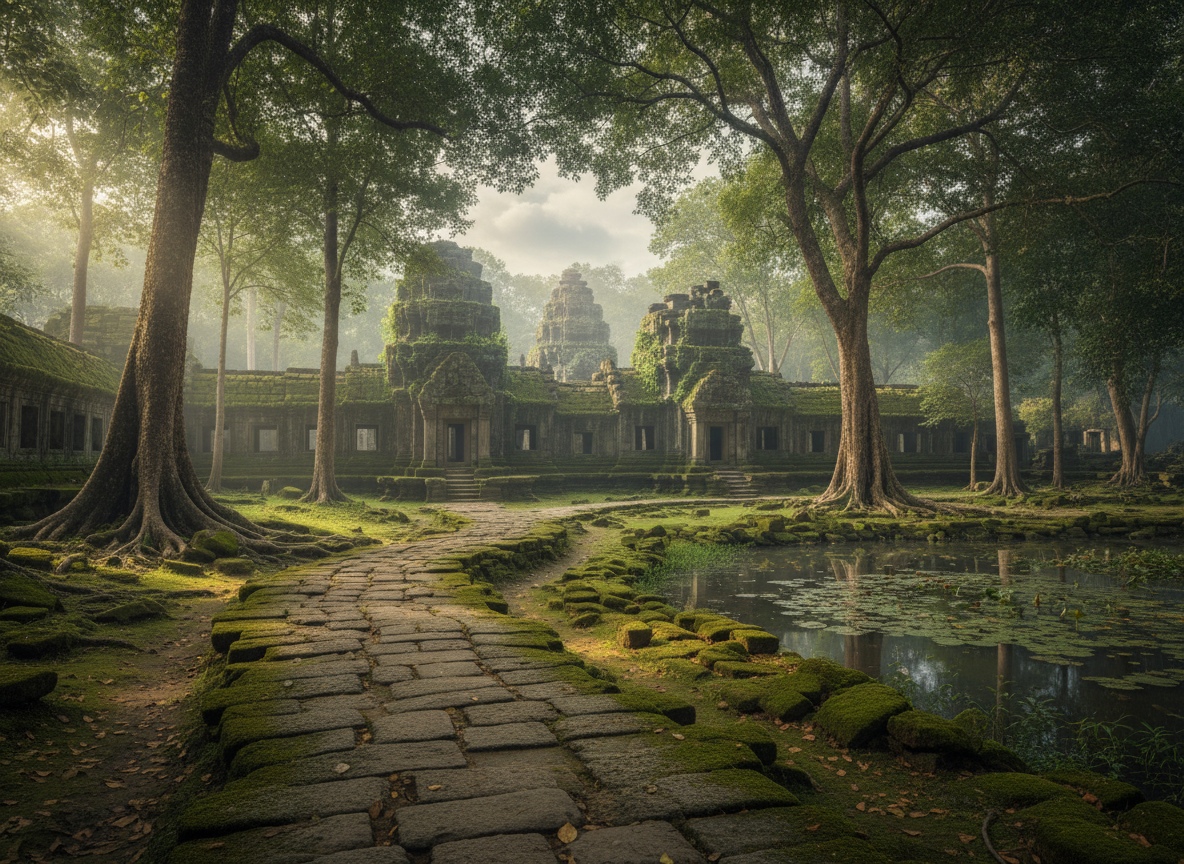
What is Kumano Kodo?
July 2022
The Kumano Kodo is one of the world’s great pilgrimage networks — a web of ancient trails threading through the Kii Peninsula of Japan, converging on three grand shrines deep in the mountains: Kumano Hongu Taisha, Kumano Nachi Taisha, and Kumano Hayatama Taisha. For over a thousand years, emperors, monks, and ordinary people have walked these paths in search of purification, renewal, and something harder to name. The forests are dense, the rivers cold and jade-green, the air thick with the quiet insistence that something sacred is close. I came not as a pilgrim in any formal sense, but I left feeling that the distinction perhaps did not matter.
This is the second entry in my series walking the Kumano Kodo. Today I am not in the forested mountains. I am on the coast — the wild, wind-scoured Mie coastline where the Iseji route meets the sea. Two sites drew me here, each strange and luminous in its own way: Onigajyo, the Demon’s Castle, and Hanano Iwato, the Flower Cave. Between them, they offered something I had not expected — not the solemn grandeur of the inner mountain shrines, but something rawer, older, and harder to explain.
Onigajyo — The Demon’s Castle
Onigajyo rises from the coast near Kumano City like something dreamed by a violent sea. The name means Demon’s Castle, and standing before those great erupted masses of rock — columns and ridges of rhyolite thrown upward by ancient volcanic force, then carved for millennia by the Pacific — the name does not feel like mythology. It feels like description. The formations are immense and chaotic, piled one upon another in configurations that have no business existing, and yet there they are, glistening darkly in the spray.
Legend holds that the castle was the stronghold of demons — oni — who terrorized the coast until the hero Yorimitsu came and slew them. I walked among the rocks and tried to summon the story, but what I found instead was atmosphere so thick it needed no narrative. The wind was constant, the ocean below a serious and pewter grey, and the rocks themselves seemed less like geology than like characters — each one particular, each one possessed of some arrested motion, as though caught mid-transformation between demon and stone.
There are boardwalks and viewing platforms, and I was grateful for them — the rocks are slick with salt and sea-foam, and the drop to the water below is unambiguous. But the infrastructure does nothing to diminish the strangeness of the place. I stayed longer than I had planned, drawn not by any particular sight but by the feeling of being in a landscape that existed entirely on its own terms, indifferent to human presence, magnificent in that indifference.
Hanano Iwato — The Flower Cave
A short drive south along the coast brought me to a different kind of wonder. Hanano Iwato — the Flower Cave — is a sea cave shrine tucked beneath towering cliffs on the Mie coast, accessible only at low tide, when the sea draws back to reveal a passage into the rock. I arrived in the late morning, tide already retreating, and picked my way across the exposed sea floor toward the cave’s dark mouth. The cliff face above was draped in green and, improbably, scattered with wildflowers growing from the cracks — the source, I understood, of the name.
Inside, the cave opens into a cathedral space of dripping rock and filtered light. A small Shinto shrine sits at the back, tended by unseen hands, fresh offerings set before a simple altar. The legend associated with this place is ancient and layered: the cave is said to be connected to the myth of Amaterasu, the sun goddess, who once hid herself in a cave and plunged the world into darkness — and who was eventually coaxed out by the laughter and revelry of the other gods. Whether or not this is the cave of that story, the association brings with it a certain quality of attention. You look at the shrine, at the flowers, at the light sliding in from the sea, and you feel how thin the membrane between the ordinary and the sacred can become.
The spiritual atmosphere of Hanano Iwato is entirely different from Onigajyo. Where the Demon’s Castle is confrontational and elemental, the Flower Cave is quiet and gathered, a place that seems to hold its breath. Visitors speak softly here without being told to. The flowers at the entrance — tiny, tenacious things rooting in pure cliff-face — feel like an argument for something, though I could not say quite what. For gentleness, perhaps. For the persistence of beauty in improbable places.
Walking Between Worlds
What I found at Onigajyo and Hanano Iwato was not what I expected from a pilgrimage route. There are no mountain temples here, no incense, no stamping books. There is only the coast, the wind, and these two extraordinary formations of rock and sea that people have been coming to for centuries because something in the landscape demands a response. The Kumano Kodo has always accommodated a wide range of pilgrim: the devout and the doubtful, the walking-wounded and the merely curious. What matters, I think, is not the reason you come but the quality of attention you bring. Both sites gave me something to attend to. Both sites gave it generously.
There is a kind of walking that is less about reaching a destination than about remaining present through the passage between one place and another — between Onigajyo’s exposed ferocity and Hanano Iwato’s gathered hush, between demon and flower, between the world of force and the world of grace. Ancient pilgrims on the Kumano Kodo understood something about this that we are still learning: that the sacred is not located in a specific building or object, but in the quality of encounter. That encounter can happen anywhere. It can happen in the dark mouth of a sea cave, in the spray off a volcanic rock formation, in the wildflowers that have chosen, without explanation, to bloom on a cliff face above the Pacific.
लोकाः समस्ताः सुखिनो भवन्तु
Leave a Reply