According to many websites, the Triund Trek is considered one of the easiest Himalayan treks, but that description can be quite misleading. We saw many hikers beginning the climb from Bhagsu Waterfall, even though this route is steep, poorly maintained, and covered with loose pebbles that make the ascent both difficult and potentially dangerous. If you start late in the day, there is little chance of reaching Triund before nightfall.
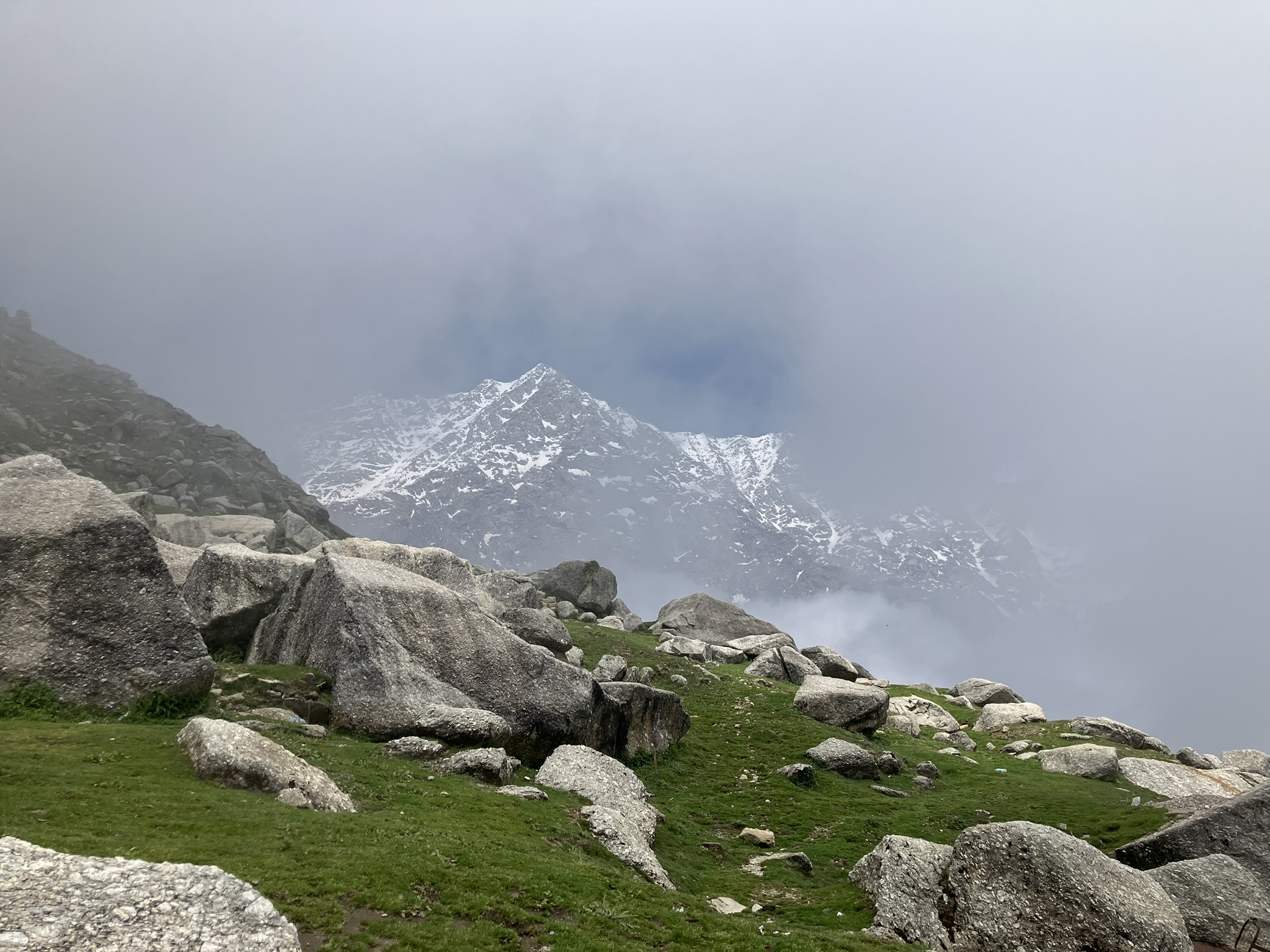
Instead, we took a taxi to Gallu Devi Temple and began the trek from there, following a much gentler and better-maintained trail. After about two and a half hours of relatively easy walking, we arrived at Triund, where we sat on a wide grassy ridge facing the breathtaking snow-covered peaks of the Dhauladhar Range.
The weather was cloudy that day, so the mountains only revealed themselves briefly whenever the clouds parted, like a curtain opening for a few quiet moments. Even so, it was easy to imagine how overwhelming the view must be on a clear sunny day, when the mountains stand fully exposed against the sky.


It is possible to camp overnight at Triund and even continue trekking further towards the snow-covered peaks beyond. However, anyone planning to do so should be prepared for the lack of basic facilities, including toilets, clean drinking water, and reliable food options.
We decided to descend via the steeper and poorly maintained trail towards Bhagsu Waterfall, though it did not take long for us to regret not returning the way we had come. The loose stones and rough condition of the path made the descent far more tiring than expected. In the end, however, it was not as bad as we had feared, and we managed to make our way to the waterfall in about two and a half hours.


A short walk from Bhagsu Waterfall stands the ancient Bhagsunag Temple, a Hindu temple dedicated to Shiva and the serpent deity Bhagsunag. According to local legend, a king named Bhagsu, while searching for water, encountered the serpent deity and fought him over a sacred water source. After being defeated, the king repented and sought forgiveness, and the land was thereafter blessed with an abundance of water.
The temple is also known for its natural spring pool, whose waters are believed to possess healing properties.


McLeod Ganj has changed dramatically since my first visit in 1991. The town has become far more populated, developed, and crowded, with countless hotels and apartment buildings now covering the hillsides, some still standing unfinished. In certain areas, inadequate sewage treatment has also left the streets with an unpleasant smell.
Yet despite these changes, McLeod Ganj remains one of the most unique places in India to experience the spirit of Tibetan culture and tradition. The journey became even more meaningful for me because it gave me the chance to reunite with my Muslim friends from Kashmir after thirty-five years, adding a deeply personal layer to the experience.


लोकाः समस्ताः सुखिनो भवन्तु
Leave a Reply