Ooty and Coonoor in Tamil Nadu are two of the most beautiful hill stations in the Nilgiri Hills and are considered the heart of the Nilgiri tea country. Ooty sits at an altitude of about 2,240 metres above sea level, where the cool mountain climate and frequent mist create a tranquil atmosphere. Coonoor, by contrast, lies at around 1,850 metres, about an hour’s drive downhill from Ooty, and enjoys a milder climate with clearer views of the surrounding hills. It is here, amidst rolling tea plantations and misty mornings, that I embarked on an unforgettable tea tasting in Coonoor, exploring the nuances of some of India’s finest teas.


Nilgiri is one of India’s three major tea-growing regions, alongside Assam and Darjeeling. Its tea is renowned for its delicate fragrance, smooth flavour, and bright amber liquor. To learn more about this celebrated tea, we visited Tranquilitea in Coonoor for an estate tour and tea tasting in Coonoor hosted by its owner, Mr. Sandeep Subramani. The estate sits nestled within the verdant hills, surrounded by terraced tea gardens that cascade down the mountainside, creating a picturesque landscape that shifts between emerald green and misty blue depending on the time of day.
Sandeep first took us to the tea plantation just outside his beautiful home, where we were able to see and feel the tender tea leaves growing on the bushes. He explained that all tea comes from just two main botanical varieties, the Chinese tea bush and the Assam tea bush. Yet from these two plants come thousands of distinctive teas, each with its own character, shaped by the terroir, including soil composition, altitude, rainfall, and temperature, as well as by the craftsmanship involved in processing the leaves, such as the timing of harvest, the degree of oxidation, and the methods of rolling, drying, and firing. The Nilgiri region’s unique elevation and cool climate are perfectly suited to producing lighter, more delicate teas—particularly Nilgiri black tea with its characteristic fruity and floral notes, as well as exceptional green and white teas that showcase subtle complexity.
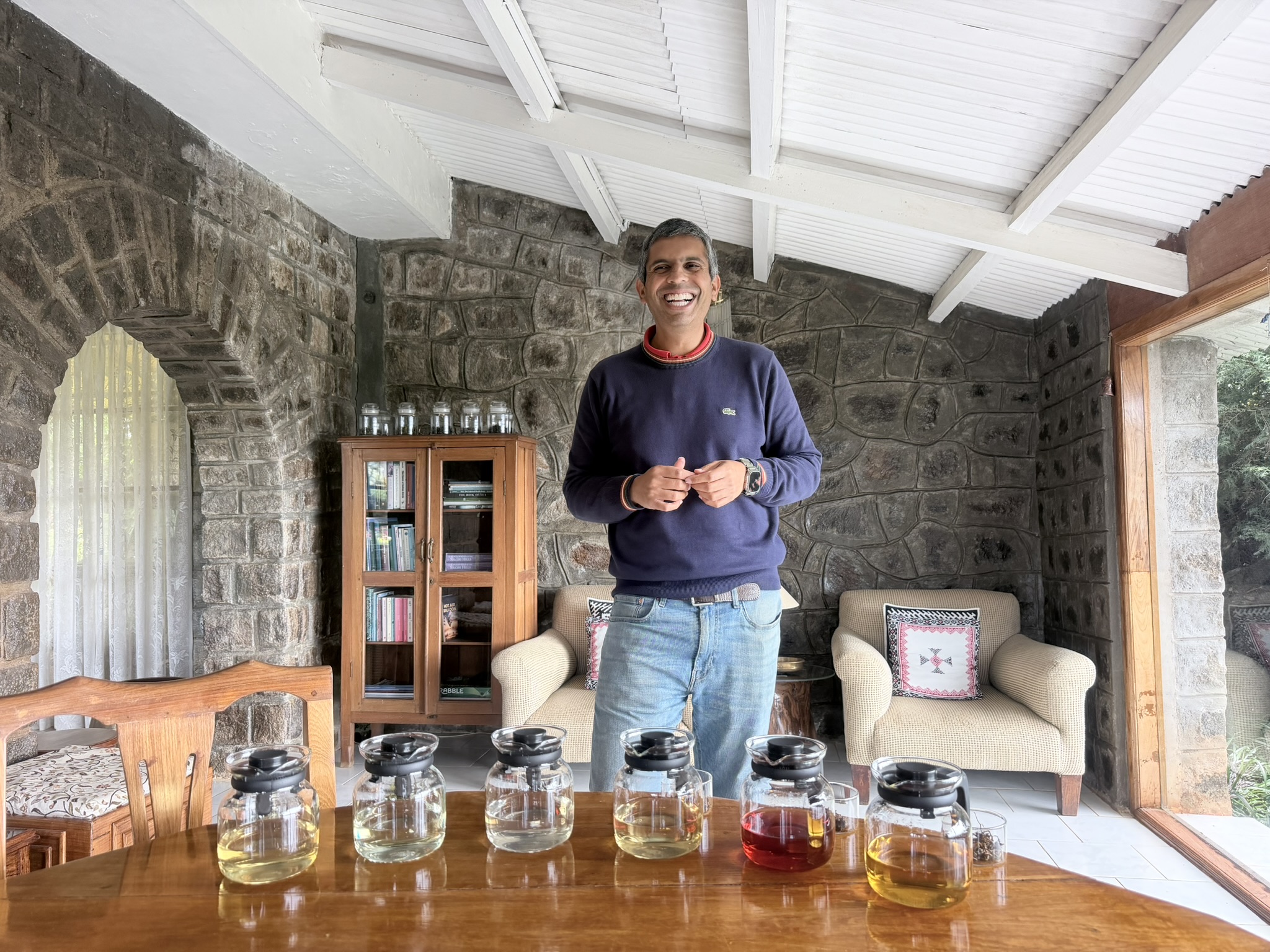
Back inside, he introduced us to six different varieties of homegrown Nilgiri tea, displayed in elegant glass jars, and explained how differences in processing create their unique characteristics. We learned that Nilgiri black tea, when properly oxidized, develops a bright, malty character with hints of citrus and stone fruit. The green teas, left largely unoxidized, retain grassy and vegetal notes with a crisp, refreshing finish. The white teas, picked from the youngest buds and leaves, offered the most delicate profiles—subtle floral aromas and a naturally sweet, almost honeyed quality. Meanwhile, each tea was brewed in a glass teapot, allowing us to observe the infusion process and appreciate how the leaves unfurled and released their colour, aroma, and flavour. Once his introduction was complete, we were invited to sample each one in turn, appreciating the remarkable diversity of flavours and aromas produced from the same humble leaf and understanding how the art of tea-making transforms simple leaves into complex, sophisticated beverages.


The tea-tasting experience taught me new ways to appreciate tea, from evaluating its aroma, flavour, and body to observing the shape and length of the leaves themselves. Sandeep guided us through a proper tasting protocol: first assessing the dry leaf, then the infused leaf, then evaluating the colour of the brewed tea in a white cup, before finally tasting and letting the flavour evolve on the palate. Long, unbroken leaves unfurl gradually during brewing, releasing their fragrance slowly and producing a more refined, layered cup. Smaller or broken leaves infuse more quickly, creating a stronger body and a brisker flavour. We learned to detect subtle notes—the fruity undertones in a Nilgiri black tea, the vegetal freshness of a green tea, the floral delicacy of a white tea. Black tea generally offers richness and depth, while white tea is prized for its delicate aroma and subtle complexity.
The experience also made me reflect on my own tea-drinking habits. A cup of black tea with milk and sugar can be wonderfully comforting, but I learnt that the proteins in milk, particularly casein, can bind to tea’s polyphenols, reducing some of their antioxidant activity. If I am drinking tea primarily for its health benefits, it is better enjoyed without milk or sugar.
For visitors planning a tea tasting in Coonoor, there are several practical considerations to maximize the experience. Sandeep advised that the best time to visit a tea estate is during the picking season, typically from April to November, when you can observe the dynamic activity of the gardens and the freshest leaves being harvested. When you arrive, expect to spend several hours: a guided walk through the plantation, an explanation of processing methods, and a leisurely tasting session with tea and often light refreshments. Many estates, including Tranquilitea, offer intimate, personalized experiences rather than large group tours, which allows for genuine conversation and deeper learning. When I’m busy, I often reach for a tea bag simply for convenience. During the tasting, however, I learnt that many tea bags contain plastic, which can release large numbers of microplastic particles when steeped in hot water. Sandeep also explained that loose-leaf tea brewed in a teapot allows the leaves enough room to unfurl fully, producing a more nuanced flavour. He recommended choosing single-origin teas rather than blends whenever possible, as they allow the unique character of a particular region and harvest to shine through.
Since returning home, I have found myself reaching more often for white, green, and oolong teas. I now brew them in a teapot, taking the time to appreciate not only their health benefits but also the subtle flavours I had never truly noticed before.
ॐ लोकाः समस्ताः सुखिनो भवन्तु


Leave a Reply